










Within the high-speed logistics transportation environment, the efficiency of on-site cargo loading and unloading of trucks and trailers has a significant effect on overall operation productivity and cost-effectiveness. Slowing the process of loading and unloading will lead to increased transportation time, higher labor cost, and even interference in the supply chain. Mobile loading ramps have been a game-changer, enabling quick and easy transfer of loads between the ground and vehicles. Next will explain how mobile loading ramps can optimize in-site operations for truck and trailer fleets.
Quick Deployment and Adaptability
One of the biggest advantages of mobile loading ramps is their versatility to be easily deployed for varying site conditions. In contrast to permanent fixed loading docks that require a lot of time and effort to install, mobile ramps are easy to transport anywhere and set up in minutes. They have wheels or casters, allowing operators to easily shift on varying ground conditions, from asphalt roads to sites with gravel.
For example, in a busy distribution center, when many trucks arrive at the same time, mobile ramps can be quickly moved to each truck, without the need for trucks to queue up at a limited number of fixed docks. In addition, such ramps can also be designed to accommodate different bed heights on trucks, to offer a smooth transition while forklifts, pallet trucks or manual handlers load and unload products. This versatility significantly reduces wait and repositioning time, maximizing the throughput of products in each load/unload cycle.
Flexibility to Accommodate a Variety of Cargo Types
Trailer and truck operations are likely to include the handling of a vast assortment of cargoes ranging from small pallets to large, bulky equipment. Mobile loading ramps are more flexible to accommodate cargoes of various sizes and weights. Adjusting widths and lengths is offered in some ramps to allow them to be adapted to the distinctive dimensions of the cargo.
For example, when loading heavy construction equipment onto a flatbed trailer, a heavy-duty mobile ramp with high load capacity can be used. The ramp surface is usually made of non-slip surface, ensuring that the machinery remains stable during the transfer process. Conversely, smaller and lighter packages can be facilitated by narrower and shorter ramps for optimal utilization of space as well as the reduction in the quantity of manual handling. Since mobile loading ramps are versatile and can be utilized in a wide range of industries including construction and manufacturing, and logistics.
Cost-effective Solution for Small and Medium-sized Businesses
For small to medium-sized logistics facilities with lower resources, acquiring a fixed loading dock would not be economically viable. Mobile loading ramps are an economic alternative, performing the same function but with lower costs. They are not required to be fixed like a permanent dock, saving on construction expenses, and can be shared among several locations or vehicles, further enhancing their economic viability.
In addition, mobile loading ramps are low maintenance. Most of the ramps are made from hard-wearing materials such as steel or aluminum that are immune to wear and tear. Regular inspections and minor adjustments are all that is required to keep the ramp in prime working condition. With a mobile loading ramp, businesses can achieve on-site effective cargo loading and unloading without making a massive initial investment, thus increasing economic efficiency in the long run.
Safety Features to Ensure Safe Operations
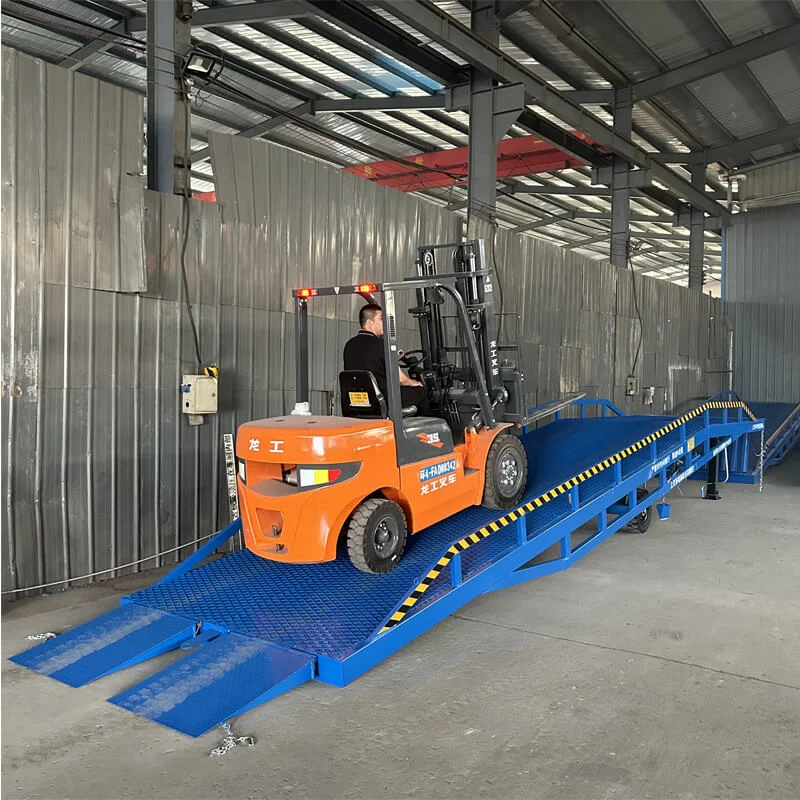
Safety is accorded the highest priority when carrying out cargo handling operations, and mobile loading ramps are provided with various safety features to provide assurance that cargo transfer operations are accident-free and safe. Some ramps feature stabilizing legs or support bars that prevent tilting or shifting when the ramps are in use. The parts can be made adjustable for application on uneven surfaces common on site, providing a stable platform for equipment and personnel.
In addition, the aforementioned non-slip surface not only prevents cargo from sliding, but also protects against the slipping of operators. Some top-of-the-range models also have side rails or guardrails to provide an additional level of protection when transporting heavy or oversized loads. Through the protection measures, mobile loading ramps decrease the risk of personnel injury. They decrease the risk of cargo damage, and they help create a safer and more efficient work environment.
Integration with Material Handling Equipment
Mobile loading ramps are designed to work seamlessly with multiple material handling equipment, like pallet carts and trucks, and forklifts. The even gradient and flat surface of the ramp allow for easy movement of the devices, providing quick and efficient transfer of goods.
Conclusion
Mobile loading ramps have become an essential tool for efficient on-site cargo loading and unloading of trucks and trailers. Their rapid deployment, adaptability, flexibility, cost-effectiveness, safety features, and compatibility with material handling equipment make them a valuable asset for logistics companies and businesses in various industries. We are the manufacturer of mobile loading ramps and look forward to your inquiry.